Showing posts with label Ubuntu. Show all posts

Friday, March 19, 2010

Democratic, Meritocratic, or Dictatorship?

Photograph of Mark Shuttleworth by Martin Schm...Image via Wikipedia
Webupd8 has an article about Mark Shuttleworth's comment on the left-side button decision which quotes from the bug report:
This is a difference between Ubuntu and several other community distributions. It may feel less democratic, but it's more meritocratic, and most importantly it means (a) we should have the best people making any given decision, and (b) it's worth investing your time to become the best person to make certain decisions, because you should have that competence recognised and rewarded with the freedom to make hard decisions and not get second-guessed all the time. 
It's fair comment that this was a big change, and landed without warning. There aren't any good reasons for that, but it's also true that no amount of warning would produce consensus about a decision like this.

> If you want to tell us
> that we are all part of it, we want information, and we want our opinion
> to be decisive.
>

No. This is not a democracy. Good feedback, good data, are welcome. But we are not voting on design decisions.

Mark
 Martin Owens makes a comment that Ubuntu is not really a meritocracy. Is that true? Is Ubuntu really democratic? Really meritocratic? Actually a dictatorship (as Mark Shuttleworth's "SABDFL" title implies)? Does it matter? Which is better for Ubuntu in the long run.

I don't think that there's anything wrong with being a dictatorship, as long as the leader is good. The Linux kernel is a reasonable example. OS X might be, too, depending on your stance on Free Software.

Shortly after it was introduced, Ubuntu leapt past other, more entrenched distros primarily because of its ability to build a large, active community. The Ubuntu Forums were almost immediately filled with people giving their time to help. Ubuntu Brainstorm came about to help identify problem areas in the distro. Ubuntu's active community is almost certainly the largest of any distro.

The activity of the community leads to the impression that Ubuntu is a community-driven project. It's not, really. Mark seems to imply in his comment that the best and brightest who further go on to prove themselves are given a kind of voting privilege or influence on the decision to be made.

From the outside, it appears to be more of a dictatorship, with advisors being appointed by merit. I'm okay with that, actually. In fact, I think more direction would be good for the project. This is FLOSS: people who don't like that model (or the direction) can change projects or fork. (I'm serious, not trolling.)

Monday, January 25, 2010

David Seigel on Improving Launchpad Bug Workflow, or "Developer, Developers, Developers"

Mark Shuttleworth and Canonical Ltd. employees...Image via Wikipedia
David Seigel has a great post, called Improving Launchpad Bug Workflow for Opportunistic Programmers < The Plenitude of Arboreal Beauty. It's not great in that I like the exact solution proposed, but it highlights some important points about Free software development, and the comments are equally interesting.

First, a summary for those not wanting to read the post. David proposes adding a simple link to Launchpad which will help opportunistic programmers fix simple bugs like the ones in 100 Papercuts without having to worry about setting up the proper build environment. Clicking "Quickly fix this bug" installs the proper dependencies and source, opens the preferred editor, and creates a patch when finished.

In effect, David is proposing that Ubuntu prescribe a specific method for bug fixes, including the IDE used. (He proposes using Eclipse.) While this type of policy is likely to rankle many programmers, I believe that having a preferred IDE, language, and toolkit for Ubuntu would be a big step forward. In fact, when Ubuntu started in 2004, I remember Shuttleworth stating that all new work should be done in Python, and that Canonical would be hiring based on this principle. SchoolTool was developed from Zope (IIRC) for this exact reason.

While there certainly have been many new additions to the Ubuntu project which rely on Python since then, we also have GTK-sharp, C, and ECMAScript or JavaScript (e.g. Seed or Gjs). Ubuntu has failed to have a single, defining vision for its product (which Shuttleworth claims he wants) with a preferred development method. I'm not suggesting that there be only one method for development, but both Microsoft and Apple have shown that providing standard tools and languages (VS/.NET and XCode/ObjectiveC, respectively) can create a great developer base. The easier to get involved, the better.

Ubuntu could have a special developers' release which includes all the standard tools necessary to set up and connect to a Launchpad account (for bug fixing and publishing via PPA), an IDE with Ubuntu- and Launchpad-specific plugins, and complete developer documentation. Of course, programmers can continue to use Vim or Emacs or whatever, then use Bazaar from the command line, but new developers would likely just accept the default method Ubuntu provided, and puting "Ubuntu" into the "integrated" part of an integrated development environment would lure many developers. (I had in my notes but forgot to mention that Ubuntu currently is developing Quickly, which appears to be going in the direction I'm proposing. Or it could die like so many other other projects. Wait and see.)

More interesting stuff comes up in the comments section: what is the responsibility for upstreaming? Should bugs be fixed upstream first? Should patches be preferred for upstream? I think these kinds of arguments overlook the strength of FOSS. Ubuntu should fix bugs as it sees fit locally first, and submit those patches or make them easily available (something Launchpad is working hard on). Ultimately, though, many proposed patches will not be accepted by upstream, or they might be delayed by years waiting for a release. If Ubuntu wants to progress, it needs to take responsibility for its own problems and not state that it is waiting on upstream to integrate or fix a patch.


Wednesday, January 13, 2010

The Plight of Ubuntu Users in Developing Countries

A landline telephoneImage via Wikipedia
Ubuntu is named after a philosophy focusing on people's allegiances and relations with each other. The Linux distribution was created by a South African to help the poor in South Africa and the whole of Africa. Sadly, most Africans are excluded from using Ubuntu because of a package choice Ubuntu made years ago.

Now, I'm not African or living in Africa: I'm a U.S. citizen living in Thailand. I don't have any first-hand experience with this situation other than the similarities between the state of rural African connectivity and rural Thai connectivity (which is surprisingly similar). I have, however, heard people around the world complaining.

Internet penetration in Africa is a paltry 6.7% of the population, compared to 27.7% outside of Africa. Moreover, Africans have very limited broadband options due to infrastructure.
Most African countries now have commercial DSL services, but their growth is limited by the poor geographical reach of the fixed-line networks. The rapid growth of Internet access has therefore been mostly confined to the capital cities so far. The introduction of mobile data and 3G broadband services is changing this, with the mobile networks bringing Internet access to many areas outside of the main cities for the first time.*
 Most Africans (both now and in the future) who have a choice of connectivity (many have no choice) have two connectivity options: dial-up and 3G data. Both of these methods use ppp to connect. Many parts of the world, including some developed countries, have similar options for connecting to the Internet.

Shockingly, Ubuntu dropped wvdial and gnome-ppp -- the command-line and GUI ppp connectors, respectively -- from the distro years ago. In order to connect to the Internet, most African users must therefore connect to the Internet (see the problem?), download the appropriate packages, and configure their dial-up or 3G connection. Just about anyone who has used Ubuntu knows that it's not particularly capable out of the box without Internet access. (Edit: Jono Bacon says that 3G connectivity is included out of the box. I don't doubt him, but all the howtos I have read used ppp. 3G must be a new addition to NetworkManager.)

So ... what was gained by dropping these two packages? Space on the CD.
What was the price of excluding most of Ubuntu's target market? 250K bytes of space on the CD. About 70% of the size of Gwibber, the Twitter client set to be included by default on 10.04.

Reblog this post [with Zemanta]

Wednesday, December 23, 2009

Ubuntu 10.04 is on the Right Track to an LTS Release

Waterfall ModelImage via Wikipedia
In Ubuntu 10.04 LTS: How we get there, Matt Zimmerman goes over the differences between the recent releases' development process and Lucid's. The major differences are:

  1. Pulling from Debian Testing, not Unstable, leading to a more polished product from the get-go.
  2. An emphasis on testing instead of features, meaning that there's actually less to test.
  3. No major changes to infrastructure. PulseAudio was introduced (and lambasted) in 8.04. No one wants to see that mess again.
  4. An early beta release (and I understand there will be two betas).
  5. Coordination with Debian's release schedule, leading to more eyes on bugs.

I had real problems with the choices for 8.04, and several things were broken on release. I'm tickled to see Ubuntu taking an LTS release extremely seriously.
Reblog this post [with Zemanta]

Wednesday, December 16, 2009

So a Man Walks Into a Bar and Asks for an Ubuntu on the Rocks

A screenshot of Linpus Linux Lite.Image via Wikipedia
Earlier today, I had to go to IT Square in Laksi to do some banking. Knowing what a geek that I am, and since  there are ten branches closer than the IT Square one, you'd be forgiven for assuming that I went to bank there as an excuse for computer shopping, but you'd be wrong. I was required to go to that specific branch. After the baning, though, my gf and I walked around a little.

She was checking out laptop bags, and my attention went to the Acer display just outside the bag store. To my shock, there was a low-end laptop (about USD400) with a localized version of Ubuntu on the computer. There was a special Acer desktop background, and the menus were in Thai.  The next computer had the same system. Hmmm. The specs described the computer as having Linpus Linux installed (pictured above), but the system was definitely Ubuntu. There were about twelve models on display, but some of them weren't on.

"Do all these computers have the same operating system?" I asked.
"These two have Windows 7," the clerk answered.

Those two computers were the high-end ones, at least 50% more expensive than any other model on display. The actual OS installed was Windows 7 Home Premium.

What's the punchline to this joke?

"But we can install Linux on those two for you if you prefer," the clerk added with a smile. "It's Open Source."

My, how times have changed! Six years ago, there were Linux computers on display everywhere, but the salespeople knew nothing about it and encouraged everyone to pay the extra money to have Windows installed.

Reblog this post [with Zemanta]

Friday, November 20, 2009

Karmic Issues That I've Faced

The CrackImage by irene gr via Flickr
Everyone has their share of Karmic Koala stories (well, not everyone, but most people). Since I had four home machines on different distributions and versions, and since I had moved to Thailand where bandwidth is somewhat limited, I decided to standardize on Ubuntu 9.10 x86 and use an apt cache to help ease the bandwidth burden for mirrors and the country.

My re-installations weren't without problems. Here are the ones I personally ran into. No hearsay here ... say. Ahem.
  • Flashing text and no X after installation, but only on one of the four. All four have i945 chips.
  • Samba (and network in general) discovery isn't working correctly.
  • Avahi doesn't work due to .local domain on the ISP's part, and disabling the check is no longer an option in /etc/default/avahi-daemon (which doesn't exist now). It's possible, but it's hard-coded into the start-up script, meaning that any updates will kill my change. 
  • One machine that tracked the beta had a completely broken GStreamer until re-installation.
  • Amazingly long Firefox freezes. I'm talking about over a minute. I've tried turned off safe browsing but that didn't change the behavior.
  • Brasero problems (of course!). Known bugs for eight months or so regarding DVD writes.
  • Totem YouTube plug-in gives DBus errors.
  • Totem Video Disk plug-in doesn't work since it uses Brasero.
None of these are show-stoppers for me, but they are certainly annoyances. One of these is hardware related. The others are just half-sharpened pencils.

Reblog this post [with Zemanta]

Is Ubuntu Too Big for Its Own Good?

I miei CD di Ubuntu ShipIt!
Image by -= Treviño =- via Flickr
After writing my post about the default applications in Ubuntu last night, I had some thoughts which Fieldyweb might agree with:
What they should do, is redesign that, take ALL the apps out of Ubuntu, other than ff add adobe flash and as many codecs, 3g ethernet and wifi drivers as they can get away with, then redesign the app store, so if you want printing, you install it from there, if you want evolution, gimp whatever you install it from there.
My opinion is that the universe and multiverse repositories contain too much software for Ubuntu to QA properly. The number of bug reports during alpha and beta is so large that many of them aren't triaged until long after release. The release bugs aren't triaged until the next version is just around the corner. Invalid is the natural response in that situation.

Ubuntu is a foundation-run project, but the software reflects on Canonical, which sells support. The Self-Appointed Benevolent Dictator for Life needs to take the lead here and move the MOTUs out of the official Ubuntu repositories and into Launchpad, Canonical's code hosting and buid server. Making optional software available in individual PPAs, will mean that Ubuntu becomes responsible for much less and can concentrate on making the applications in main, especially default applications. Canonical can work toward its stated goal of creating a worthy competitor to OS X 10.6 (Snow Leopard) and Windows 7.

What would the process of moving towards more streamlined look like? First, there would be no more mass import from Debian Unstable. Ubuntu would be responsible for the basic application and drivers necessary to run the various projects. MOTUs should be encouraged to move as quickly as possible to PPAs. AptURL should have the prohibition on PPAs removed for Launchpad.net. Finally, the Software Center needs to be reworked into a front-end for Launchpad PPAs. Backports will be responsible only for core applications (and likely only for LTS releases).

In the end, MOTUs and their PPAs would be obviously responsible for third-party package bugs which are now blamed on Ubuntu. Ubuntu development would more closely model its rivals (OS X and Windows), concentrating on the core OS and leaving the extra applications to interested parties. Users would still get one-click installation of software. Users would also stop bitching about having to upgrade in order get the newest software. The default Ubuntu install would just work.

There are some problems with this approach:
  1. Making sure users understand how to get PPA software and that the process is easy. This is solved using AptURL and one-click adding of PPAs and keys.
  2. Enforcing a packaging method in PPAs which limits or eliminates dependency conflicts. This is solved by having the software center only search for MOTU PPAs, where MOTUs are responsible for limited numbers of packages. Python bindings for Coherence (uPnP) are handled by one MOTU and Python programs which use that binding are assigned to other MOTUs.
  3. Ubuntu will definitely get some backlash for supporting fewer applications. Hopefully, this problem is mitigated by the improved quality of the core OS.
Thoughts?

What Applications Should be in the Standard Installation?

An image of a compact disc - Pencil included f...
Image via Wikipedia


You may have heard that GIMP and F-Spot aren't safe for inclusion in 10.04. 700MB isn't much space to work with Why not question all the applications in Ubuntu, then? What should be in the default installation? I'll look category by category, but I'll talk a little about why the current defaults are chosen first.

Ubuntu is first and foremost a GNOME distribution. It takes GNOME applications unless there's a definitive reason not to. For example, Firefox was originally used instead of the GNOME default Epiphany browser because Epiphany was in a terrible state at the time, and FF is still preferred because it's a very poplar browser and serves as a familiar signpost to switchers. But mostly, you've got Totem, Nautlius, Evolution, and all the gang. Ubuntu thus looks much like any other GNOME distribution.

But it doesn't have to be that way. The questions about The GIMP are great -- they represent a critical look at what should be included. How many people do advanced photo editing? Few, probably. I would guess that the same can be said for PIMminess. Has the average user even even opened Evolution? Most home users handle all their personal business through web services like Yahoo! or Google.

First of all, UBuntu needs to decide whether it wants to be a home or professional operating system. Pro users want different things out of the box. Trying to please  both sets of users with one CD is an exercise in frustration. Take a look at the table below to see what groups I think want various features (and keep in mind that it's easy to install these bits if you are an exception).

Application Class
Current Choice
Home User
Professional User
Accessories
Printing, Calculator, etc.
Yes
Yes
Games
GNOME Games
Yes, and more
No
Photo Manager
F-Spot
Yes
No
Bitmap Editor
The GIMP
No
No
Vector Editor
OO.o Draw
No
Yes
Image Scanner
XSANE
On insertion of a scanner
IM Client
Empathy
Yes
Probably no
Personal Information Manager
Evolution
Not likely
Yes
Web Browser
Firefox
Yes
Yes
Remote Desktop
VNC Client and RDP Client
No
Yes
Bittorrent Client
Transmission
Yes
No (a hundred times, "No!")
File Synchronization and Back-up
Ubuntu One
Yes
Yes, but not this one
Presentation Software
OO.o Impress
No
Yes
Spreadsheet Software
OO.o Calc
Maybe
Yes
Word Processor
OO.o Write
Yes
Yes
Disc Burner
Brasero
Yes
Maybe
Video and Audio Player
Totem
Yes
Yes
Music Manager
Rhythmbox
Yes
No

Using very rough calculations (via apt-cache show's size), the home user profile above would shave 75-80MB. That's more than enough to add more themes, a video introduction on first run, a video editor, cool games, or other things deemed useful for the home user.  The corporate user will only get 60MB or so, but you could then make a case for removing Tomboy so that Mono could be ripped out, saving even more space. What would go in instead? Certainly the would be tools for connecting to directory services. Tracker should be installed and Nautilus should have Tracker functionality re-enabled.

Ubuntu devs are constantly fighting amongst themselves about which applications deserve to be on that tiny, 700MB disk. Serving two different customer bases with one CD just makes that problem worse.

Thursday, November 19, 2009

The Fate of Photo Editing in Ubuntu 9.10 Karmic Koala

GIMP
You may have started to hear rumors that The GIMP and F-Spot aren't safe for inclusion in 10.04 Lucid Lynx. "What?!?" you say. "The GIMP has been in every GNOME distribution since GNOME existed (sinceGNOME is written to GTK, which stands for the GIMP ToolKit)." Well, well. Good idea. Not likely to move forward.

The argument goes like this:
  1. Not many people actually edit photos.
  2. Fewer people use GIMP to do the editing, since the interface may be difficult for some.
  3. Most of the editing people want to do on photos is available from within F-Spot, and thus GIMP is duplicating functionality.
I think getting rid of The GIMP in the default install is a great idea. It takes up precious space on the Ubuntu Live CD. It's easy to add later by searching for "graphics editor" or "photo editor." Unfortunately, getiing rid of the GIMP means that F-Spot needs to be examined, and it has been in a terrible state for several releases.
  • It didn't work at all on 8.04 AMD64 at release time.
  • It had an awful "the sidebar has zero width" bug for two other releases.
  • It doesn't categorize or edit photos that aren't imported, even if those photos are in the ~/Pictures folder.
The sharks circle F-Spot and say "since we're removing The GIMP, let's replace F-Spot, too. $Foo is a great project," where $Foo is one of:
  1. gThumb
  2. Shotwell
gThumb has been around for a long time (and is still the default for Fedora), but was replaced with F-Spot on Ubuntu several years ago. Are the Ubuntu developers going to admit that moving to F-Spot was a mistake? Are they going to appear to cave in to the Ubuntu users that oppose Mono apps in the default installation?

Shotwell is a new photo management app for GNOME written in Vala, and it gets decent reviews. Still, it's new, untested, and doesn't support tagging or real editing options. Check out the Shotwell PPA by entering "ppa:yorba/ppa" into the Software Sources -> Third-party tab.

So ... I don't think it's going to happen. I'd like to see this change (along with some others in the default application area), but there's not a clear path forward, and definitely not enough agreement to get a real plan.

My preference? Leave 10.04LTS alone, get it as stable and bug-free as possible, and look to replace F-Spot with Solang (install Solang) in 10.10 when GNOME 2.X gives way to GNOME 3. Debarshi Ray has put a lot of work into this project. It's a photo manager which stores tagging information in Tracker, and he's written a Nautilus plug-in which handles Tracker tags, as well.  Wouldn't it be nice if the information you entered in your photo manager was available to your other applications, and to Zeitgeist, as well?


Sunday, July 12, 2009

Just in Case

Powered by Ubuntu Linux (Sticker)Image by jcraveiro via Flickr
Just in case you're ever tempted to say something stupid like "Ubuntu is unkackable," watch this video, then re-think the statement.


The video shows a local root exploit in the Linux 2.6.30 kernel. Karmic will ship with 2.6.31 so this exact exploit isn't likely to still work. Oh, and even though the vulnerability is local, remember that remote user exploit plus local root exploit equals remote root access. ;)


Reblog this post [with Zemanta]

Sunday, June 21, 2009

Migration Assistant to Automatically Install Equivalent Programs

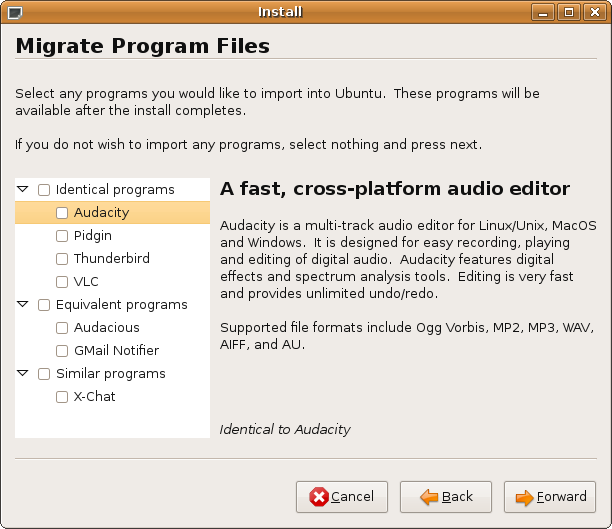
There's a new project to locate installed programs on a Windows partition and install the same or similar programs in Ubuntu during the Ubuntu installation process. The project is called Migration Assistant. Right now, the list of programs is short, but that's likely to get longer:
The Migration Assistant should offer to install (equivalents of) known programs during the installation process. The program should recognise three levels of equivalence: identical (same codebase), equivalent (different codebase, but one is specifically modeled on the other), and similar
(unrelated program that does the same job). The assistant should recognise at least the following packages:

Reblog this post [with Zemanta]

Tuesday, June 16, 2009

Why One Hundred Paper Cuts is Great but Will Ultimately Fail

I just noticed I have a bad habit of posting 3...Image via Wikipedia
I whack pretty hard on Ubuntu (and Gnome) for minor usability problems, which they deserve. One-line fixes, supplied simple patches, and erroneous error messages that go unfixed for years should be embarrassing, shouldn't they? Heck, HUBackup did nothing but segfault starting in Dapper (6.06), but it wasn't dropped from the repositories until Jaunty (9.04). That's almost three years of continuously broken packages.

There's hope on the horizon, though. One Hundred Paper Cuts is "A project led by Canonical's Design and User Experience team to improve user experience in Ubuntu by identifying 100 small points of pain for users, or "paper cuts", and healing them!" Unfortunately, many more bugs have been reported than the required 100, and these bugs need to be triaged. Users are encouraged to look for bugs that don't meet the criteria:

  • bugs that are system-wide (Nautilus, Gnome panel, etc), rather than app-specific (F-Spot, OOo, Terminal, etc.)
  • bugs that impact standard workflows (like connecting to the network, copying files, browsing folders, etc.), rather than specialised or corner case workflows
  • bugs that are easy to address, rather that ones that require significant design or development efforts
  • issues with existing features, rather than requests for new features
  • bugs that relate to usability and design (like size of the notification bubbles), rather than broken software (e.g. notifications flickering in fullscreen)
Non-conforming bugs need to be marked "Invalid." Unfortunately, the above criteria are broad enough that just about any bug can be excluded if the triage-er (I'm pretty sure that's not a word) doesn't like the bug. Even more sadly, the first and last points exclude real usability problems, like default applications with major usability bugs that could be fixed in moments (but wont be) or broken software that's also easily fixed (but isn't, for some reason).

My prediction? 100PC will ultimately fail because of:
  1. Politics over which bugs are "important"
  2. Real problems on the desktop that could be targetted will be marked "Invalid" because they don't affect Nautilus or Gnome Panel (or even if they do).
Reblog this post [with Zemanta]

Thursday, May 28, 2009

Well, That's One Reason to Support Thin Clients, I Guess

Ubuntu logoImage via Wikipedia
A Canberra area prison is getting some new computers after a successful trial. These computers are running Ubuntu, but instead of being full PCs, they're net-booted and all the applications are run locally. Shutting off a computer remotely is easy, and it can't be bypassed because there's no software on the machine. The guards never even have to leave the server.

There are IT training courses on how to use the machines, and they are full. "The interface we chose was designed to resemble Windows as closely as possible so when prisoners are released back into the community they are still familiar with where things are in the Microsoft [operating system]," Andreas Wullen, business and security systems manager for ACT Corrective Services, told iTnews in Aussie prisoners escape lock-in with Ubuntu PCs.
Reblog this post [with Zemanta]

Wednesday, May 27, 2009

Linux Mint 7 (Gloria) is Available.

My Linux MintImage by plynoi via Flickr
 Linux Mint vesions normally trail the Ubuntu versions they're based on by about a month. Mint 7 is based on Ubuntu, so it has most of the same new features that Jaunty has, plus the extras normally in Mint.

Mint doesn't think about the problems of software patents and codec licensing, and ships things like restricted codecs and drivers and Flash already installed. The Moonlight plugin (Mono's Silverlight) is also pre-installed. It eschews Gnome's two-panel display and goes for a more Windows-like look. These three "features" make it a great choice for curious users coming from the Windows side of life.

Mint 7 has an updated main menu which sports suggestions which include installing applications if they aren't available in the menu. The installation application has a new set of "recommended" software which are the most requested ones (e.g. Skype, Google Earth, Opera, etc.) and are installable without searching further. The updater has been ... umm ... updated to conform with Gnome's HIG.


Overall, Mint 7 looks to be a solid release. Get the torrent for the CD or the DVD.

Reblog this post [with Zemanta]

Random Thoughts on Random Tech Stories

Some interesting tech stories from this week and a little commentary.
  1. Facebook value plummets $5bn
    Facebook is ad-driven. The ad market is down. Shock!
  2. Apple counts $1bn for mystery data center
    Twice the cost of the average Google data center: XServes cost twice as much as the average Google server. ;)
  3. Ubuntu AppCenter and Android apps on Ubuntu
    The App Center (in other words, an app store) is now high priority for 9.10, and UDS is showing off Android apps. Hmmmm. These couldn't be related in any way, could they?
  4. UNR doesn't have vision
    Summary: Netbooks aren't small notebooks. We need to treat them differently and the Internet has to be woven into every interface.
    Take: I agree on the intent of using a netbook, but the market (and I mean customers) dont, and are pushing to make them small, cheap notebooks. Good luck changing their minds.
  5. Free software will kill Redmond
    Redmond ain't dying any time soon, folks. There's one real truth here, though: Free and Open Source software are going to destroy 90% of the market for software sales (not implying that total software-related income will drop). Once a class of app is commoditized in FOSS, you'll need good luck selling a license for similar software. What will be left? Niche markets and service contracts (including web services).
  6. Linux desktop adoption "easier than expected"
    The Linux desktop is ready for the enterprise. Businesses have the ability to start with more amenable groups and expand the roll-out later. Once the change is obviously permanent, people deal with the change.
  7. Video Editing On Linux: Things are looking up!
    Keep holding your breath. Don't start breathing yet. Pitivi is still massively buggy, but it's getting there.


Reblog this post [with Zemanta]

Saturday, May 16, 2009

Playing with a D2D update and Debian Pre-Seeds

Debian OpenLogoImage via Wikipedia
I've been mulling over what I want to do to update my D2D project, and I'm considering using Ubuntu 9.04 Jaunty because the default inclusion of the Coherence uPnP plugin makes my video-sharing work a lot easier. That and the photo sharing were the two parts I didn't finish last summer. In summary, I need to
  1. Set up a simple uPnP server (likely ushare) on the D2D server automatically sharing /home/Videos, and
  2. Write a DPAP server (iPhoto sharinng protocol) in Perl and install an F-Spot plug-in.
  3. Change the crappy Tangerine DAAP server back to mt-daapd since it has been re-included in Lenny and is also in Jaunty.
These are pretty trivial, actually.

My major problem with D2D right now is the "bug" in Debian Lenny and Ubuntu Jaunty where many ISPs and routers use a .local domain which disables Avahi/Zeroconf. This is not really a bug -- it's desired behavior, but it gets in my way. The check for the .local domain can be disabled, but to do that by default on D2D is not the way to go. Leaving the bad behavior means that D2D doesn't actually "just work" for half of the folks who will install it. I'm kind of at an impass right now.

The Debian Pre-seed project still works as expected and doesn't really need to be updated, but I've been using Google Pages as a cheap host (files up to 10MB), which is now being moved over to Google Sites. The migration is automatic, but I'm likely to lose some files for a few days. I backed them all up in that case.

Reblog this post [with Zemanta]

Wednesday, May 13, 2009

About UbuntuOne -- The Post That is Sure to Piss Someone Off

I've been waffling for a couple of days over whether to write this post or not. I finally decided to just speak my mind.

UbuntuOne is a new service from Canonical that's currently in Beta testing. It doesn't differ in any important way from similar services like DropBox or Box.net, except that it's integrated and designed specifically for Ubuntu (9.04 Jaunty is required). The client is still immature, but it will probably eventually include useful services like integration into Conduit Sync and desktop settings. Once that kind of integrated functionality appears, people will probably line up to pay the USD10 for 10GB of storage.

Unfortunately, Canonical is playing this on-line service the same way they play their others -- closed source. Just like Launchpad, the server software isn't open (though the client is). Why does it choose to do that?

It's not necessary to keep either closed, you know. Launchpad offers a great way for teams to work together, but its value isn't in the code as much as it's in the community behind it. Facebook could open its code, too without any worry of someone building a copy. Launchpad links teams and code. Nobody is going to replace it.


UbuntuOne will eventually be integrated into Ubuntu. Users will be able to share files with others on the service. It will be half backup and half social. No matter whether there's an open version of the server or not, the vast majority of users will be on UbuntuOne instead of WannabeOne because that's where everyone else is and getting set up is much more convenient to use the included client than downloading a different client setting it up with the other service.

In both cases, Canonical gains little by playing both sides of the fence, offering closed-source solutions as an open-source business, but it loses a lot of community support. Red Hat, on the other hand, is a pure open-source company, and has no problem:
  1. Offering amazing platforms like the Fedora Directory Server completely openly, and
  2. Making money off of the software service.
Very few FOSS advocates have a problem with dual-licensing projects like MySQL or QT (before the acquisition) selling licenses to closed-source projects, but that's not what we're talking about here. This is more like SUSE's old model of keeping YaST closed (it was GPLed in 2004). That, too, kept a lot of people off balance with regard to SUSE. The open source business isn't one that you can stick one foot into -- you have to jump in all the way.

Most Ubuntu users aren't aware of the FOSS philosophical arguments, but that doesn't change the business arguments. You can't promote open source while holding some of your cards close to your chest. How can I trust you when you say one thing and do another?

Ulitimately, it's Canonical's call and it's their code. They get to license it any way they want to. I still think they're shooting themselves in the foot.


Reblog this post [with Zemanta]

Friday, April 24, 2009

The Big Picture: Timed Release Failures

Ubuntu DVD Case RenderImage by Andrew Mason via Flickr
Jaunty should be out today (this post is scheduled), and I think  this is a good time to talk about whether timed releases are a good idea. I'll put my opinion out here at the beginning and say that, from a project management standpoint, hard release schedules are really not the way to go. Let's look at Ubuntu 9.04 Jaunty as an example.

There's a giant bug in Brasero that doesn't let a user create a video CD or DVD. Brasero claims to have this function; it appears to have this function by virtue of there being a button for it; but attempts fail because it claims that it's not possible with the available plugins. This also breaks Totem VCD/DVD writing, one of the bullet points for this release. A fix is available and in a PPA, but it's apparently (as of T minus one day) not going to be included because of the package freeze. They can't test the package and get it included in the CD on time.

That leaves a choice: push the release back a couple of days, or ship with a major bug.

Canonical used to be a little more flexible with its shipments: 6.06LTS (Dapper Drake) was delayed two months because they wanted to hammer out a few bugs. About the time that 8.04LTS came out, though, Canonical became much more serious about the day they were to release on. Countdown clocks were part of the marketing effort, and if they're showing a release but one doesn't appear, that looks really bad for the project.

As a result, 8.04LTS (Hardy Heron) shipped with a bug which prevented F-Spot from launching a second time on AMD64. The first time worked, but a late change in mono left the default photo application for the OS segfaulting on startup when run the second time. It didn't get fixed for a couple of weeks. Ubuntu 9.04 (Jaunty Jackalope) will likely have a similar (but not quite as serious) bug in the shipping version because of Brasero.

There's the other side of the argument which says that there'll always be bugs and that you just need to ship, anyway, but that's why some bugs are called  "release critical" and you need to correct them if at all possible. That "posible" thing includes delaying the release for a week.

Timed releases are fine, but don't shoot yourself in the foot. Be flexible enough to put out a good product. You can't be taken seriously by real users if you ship non-functioning product regularly. That's the big picture.

Reblog this post [with Zemanta]

Monday, April 20, 2009

Fix Your Crap 1: Want Tracker Support in Nautilus?

Nautilus ubuntuImage by gigasoft via Flickr
Open up your Ubuntu Hardy (or later version) file manager and press CTRL+F to start a search. You'll notice that it's slow and only searches by name. Sure, you've got the deskbar (unless you're using a recent version of Ubuntu) and can get Tracker full text search, but why wouldn't you want Tracker integrated with Nautilus? Well, it turns out that a lot of people didn't want it and the integration was stopped after Gutsy (what a bone-headed decision that was!). Don't bother trying to report this as a bug, even though the Nautilus project and the Tracker project both claim integration with each other -- it'll just be marked "Invalid" or "Won't fix." Wake up. Modern desktops have this kind of integration.

So what's a person to do? Are you going to run off to another Gnome distro which doesn't do this? You have the power of the source. Use the source, Luke! Fix your crap. It's an easy cut and paste job for you. Just open a terminal and paste the following in (I'll explain later what each part does):

sudo apt-get build-dep nautilus
sudo apt-get install build-essential libtrackerclient-dev \
libtracker-gtk-dev fakeroot
apt-get source -b nautilus
sudo dpkg -i libnautilus-extension*.deb nautilus*.deb
killall nautilus

You should now have a near-instant search via full-text Tracker. Have fun.

The explanation
  1. We're going to need to recompile nautilus, so we need to get the build dependencies for Naultilus. The first line does this automatically without having to work through everything manually.
  2. Since the Tracker dependencies weren't installed, we need to include those. We also need fakeroot since we don't want to build as root -- fakeroot is a package which keeps us from needing to use those priveledges while building the package. Build-essential makes sure that we have all the build tools installed. I normally have them, and I'm not sure whether you actually need to have this package on the second line or not (due to build-dep above), but it doesn't hurt to have it and I don't want anyone's build failing. The backslash in the middle of that line makes a carriage return possible without executing the command.
  3. We retrieve the source for Nautilus and automatically build it. Since Nautilus checks for Tracker during compilation, we don't need to mess with any compilation flags -- that's handled automatically.
  4. We install the new packages.
  5. We need to kill Nautilus to restart it.
Sometimes, changing your system to meet your needs is more difficult than this. I'll introduce you to one of those next week in Fix Your Crap 2.
Reblog this post [with Zemanta]

Saturday, March 14, 2009

OpenOffice and GVFS-FUSE

 As of openoffice.org 1:3.0.1-5ubuntu1 in Ubuntu Jaunty OOo will be using gvfs fuse instead of gnome-vfs or gio. This is because both gnome-vfs and gio support in OOo is buggy. Currently gnome-vfs fails to save documents properly and enabling gio causes OOo to not start at all. Of course using gvfs fuse has exposed numerous bugs as well, before gvfs 1.1.8 it did not support ftruncate well enough for OOo to save files. It does work now but there are still a few bugs with saving to ftp and webdav.
Wow! Talk about pain .... This has the potential to be a train-wreck in the same way PulseAudio + Adobe Flash was in 8.04. Loss of data? I hope this is ironed out before Jaunty goes gold!


Reblog this post [with Zemanta]

Other I' Been to Ubuntu Stories

Related Posts with Thumbnails