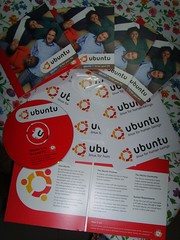
Pulling from Debian Testing, not Unstable, leading to a more polished product from the get-go.
An emphasis on testing instead of features, meaning that there's actually less to test.
No major changes to infrastructure. PulseAudio was introduced (and lambasted) in 8.04. No one wants to see that mess again.
An early beta release (and I understand there will be two betas).
Coordination with Debian's release schedule, leading to more eyes on bugs.
I had real problems with the choices for 8.04, and several things were broken on release. I'm tickled to see Ubuntu taking an LTS release extremely seriously.
After writing my post about the default applications in Ubuntu last night, I had some thoughts which Fieldyweb might agree with:
What they should do, is redesign that, take ALL the apps out of Ubuntu, other than ff add adobe flash and as many codecs, 3g ethernet and wifi drivers as they can get away with, then redesign the app store, so if you want printing, you install it from there, if you want evolution, gimp whatever you install it from there.
My opinion is that the universe and multiverse repositories contain too much software for Ubuntu to QA properly. The number of bug reports during alpha and beta is so large that many of them aren't triaged until long after release. The release bugs aren't triaged until the next version is just around the corner. Invalid is the natural response in that situation.
Ubuntu is a foundation-run project, but the software reflects on Canonical, which sells support. The Self-Appointed Benevolent Dictator for Life needs to take the lead here and move the MOTUs out of the official Ubuntu repositories and into Launchpad, Canonical's code hosting and buid server. Making optional software available in individual PPAs, will mean that Ubuntu becomes responsible for much less and can concentrate on making the applications in main, especially default applications. Canonical can work toward its stated goal of creating a worthy competitor to OS X 10.6 (Snow Leopard) and Windows 7.
What would the process of moving towards more streamlined look like? First, there would be no more mass import from Debian Unstable. Ubuntu would be responsible for the basic application and drivers necessary to run the various projects. MOTUs should be encouraged to move as quickly as possible to PPAs. AptURL should have the prohibition on PPAs removed for Launchpad.net. Finally, the Software Center needs to be reworked into a front-end for Launchpad PPAs. Backports will be responsible only for core applications (and likely only for LTS releases).
In the end, MOTUs and their PPAs would be obviously responsible for third-party package bugs which are now blamed on Ubuntu. Ubuntu development would more closely model its rivals (OS X and Windows), concentrating on the core OS and leaving the extra applications to interested parties. Users would still get one-click installation of software. Users would also stop bitching about having to upgrade in order get the newest software. The default Ubuntu install would just work.
There are some problems with this approach:
Making sure users understand how to get PPA software and that the process is easy. This is solved using AptURL and one-click adding of PPAs and keys.
Enforcing a packaging method in PPAs which limits or eliminates dependency conflicts. This is solved by having the software center only search for MOTU PPAs, where MOTUs are responsible for limited numbers of packages. Python bindings for Coherence (uPnP) are handled by one MOTU and Python programs which use that binding are assigned to other MOTUs.
Ubuntu will definitely get some backlash for supporting fewer applications. Hopefully, this problem is mitigated by the improved quality of the core OS.
I've been mulling over what I want to do to update my D2D project, and I'm considering using Ubuntu 9.04 Jaunty because the default inclusion of the Coherence uPnP plugin makes my video-sharing work a lot easier. That and the photo sharing were the two parts I didn't finish last summer. In summary, I need to
Set up a simple uPnP server (likely ushare) on the D2D server automatically sharing /home/Videos, and
Write a DPAP server (iPhoto sharinng protocol) in Perl and install an F-Spot plug-in.
Change the crappy Tangerine DAAP server back to mt-daapd since it has been re-included in Lenny and is also in Jaunty.
These are pretty trivial, actually.
My major problem with D2D right now is the "bug" in Debian Lenny and Ubuntu Jaunty where many ISPs and routers use a .local domain which disables Avahi/Zeroconf. This is not really a bug -- it's desired behavior, but it gets in my way. The check for the .local domain can be disabled, but to do that by default on D2D is not the way to go. Leaving the bad behavior means that D2D doesn't actually "just work" for half of the folks who will install it. I'm kind of at an impass right now.
The Debian Pre-seed project still works as expected and doesn't really need to be updated, but I've been using Google Pages as a cheap host (files up to 10MB), which is now being moved over to Google Sites. The migration is automatic, but I'm likely to lose some files for a few days. I backed them all up in that case.
Congratulations to Steve McIntyre on his re-election as Debian Project Leader. I hope he has another great year. The original e-mail reads:
Hi,
The winner of the election is Steve McIntyre.
His new term will start on April 17th, 2009.
The details of the results shall soon be available at: http://vote.debian.org/2009/vote_001
In the mean time the results are also available at: http://master.debian.org/~secretary/leader2009/results.txt http://master.debian.org/~secretary/leader2009/results.png
The tally sheet is at: http://master.debian.org/~secretary/leader2009/tally.txt
The list of people voting is at: http://master.debian.org/~secretary/leader2009/voters.txt
Despite delays, Debian Lenny is due on Valentine's Day, February 14th, and there are sure to be many users who fall in love with one of the original and most stable Linux distributions around. What will you find in the release?
Stability
The Debian devs spent an extra five months past the planned launch date making sure that the system is as bug free as possible. Lenny will be supported for two more releases, translating into about four years of support.
A Butt-load of Packages
There are somewhere in the range of 14,000 packages (miksuh corrects my number to 22,000), supposedly more than any other distribution. If you're used to Ubuntu, you'll find just about every package in Ubuntu's repositories are in Debian's, plus some.
Because of the long freeze during bug fixing, though, many of these packages are behind the six-month distributions. They are actually mostly on par with Ubuntu 8.04. The highlights are:
Kernel 2.6.26
Gnome 2.22 (mostly -- Nautilus and the panels are from 2.20 because of gvfs problems).
Some hardware firmware, especially for wireless devices.
Non-free programs like Parallels in the Canonical Partner repository.
A lot of the missing packages can be found in Debian Multimedia, a third-party repository. Thanks, miksuh, for reminding me to mention it.
Many Platforms
Debian supports a huge number of architectures. In addition to the normal x86 and AMD64 arches, there is support for armel, mips, sparc, and others. Debian will run on just about anything, which is why Debian already runs on the G1 Android phone.
An Easy (But Textual) Installer Debian's installer doesn't look nearly as pretty as Ubiquity (Ubuntu's installer), but it is actually the same one present in the Ubuntu alternate install. Very few questions require any thought, and the default answers are acceptable for most normal installs.
What the textual installer gives Debian is cross-platform installability. The same installer works on all supported platforms.
As miksuh pointed out in the comments, and I completely forgot, there are other options:
A GTK installer which has exactly the same dialogs as the text editor, and
As mentioned in the first section, Lenny offers a number of great desktops to choose from. In addition to Gnome, KDE, XFCE, and LXDE, there are truly minimal choices included EvilWM, DWM, FVWM(-Crystal), IceWM, TinyWM and Window Maker. Debian is anything you want it to be.
Security
Debian is secure. Neede patches are now applied before the first boot. Packages use GCC hardening in some cases. Other hardening has occured, setuid inaries have been reduced, and the number of open ports has been furhter limited.


![Reblog this post [with Zemanta]](https://lh3.googleusercontent.com/blogger_img_proxy/AEn0k_vqjduBb8YSFM_aZl4d88PgnabxT7kFJVkl75CGKvrjN9LnZV5rQsNvPN_9xihdE0x06llb_sAVCHkJqdS82NAYlphoHjIrBYk7wlzYGoIqVBGRgDnSrrGyISDJBZWDivFkKjncDfiFJoHqq7qbmm52=s0-d)


![Reblog this post [with Zemanta]](https://lh3.googleusercontent.com/blogger_img_proxy/AEn0k_ttnW9HeQYyyP-PA6Y-DE2Nluk8aRmxDmLJLr5KoA2zisyLnn1GSfrP0RG-1PxWv255JEHxPWehJfMwTLWgHOxd-kgEds8YNlvj_NGGzRLeX3hbY6Km61qGxauacFk1omvwldjSE8Cn0c_FAWQtGe4=s0-d)
![Reblog this post [with Zemanta]](https://lh3.googleusercontent.com/blogger_img_proxy/AEn0k_sxH9zeGUopkCaqE2oC6ewRQDBIkjNB8zMNlVIXFYZR9myoRo-BLch-LQD_6Emcs_K-NYsS81F_qSwshUCCT2JumD9gGo2ABBt_sZkh1kC8AZ97L0pukSXcmIgS06jLyIvsgxDpPm1ZVEM2Qnoqt-cf=s0-d)
![Reblog this post [with Zemanta]](https://lh3.googleusercontent.com/blogger_img_proxy/AEn0k_tOViMM-5vZWRRcR0EWe3g0Z4-BL30PZUHHozwTYWxLWa9NKQZSq3BgBQ3N7DFQ2YpALiqtPeiqMXQC3SlunXoyyfbnU2vvbQYj64WlqEm_9rKHA9qHuZcgNsB2IOvvEtXNfxPh1efC9DHyhvfnhir7=s0-d)